Bitcoin: The Sovereign Protocol—A Top Holiday Gift for 2026 Now Available
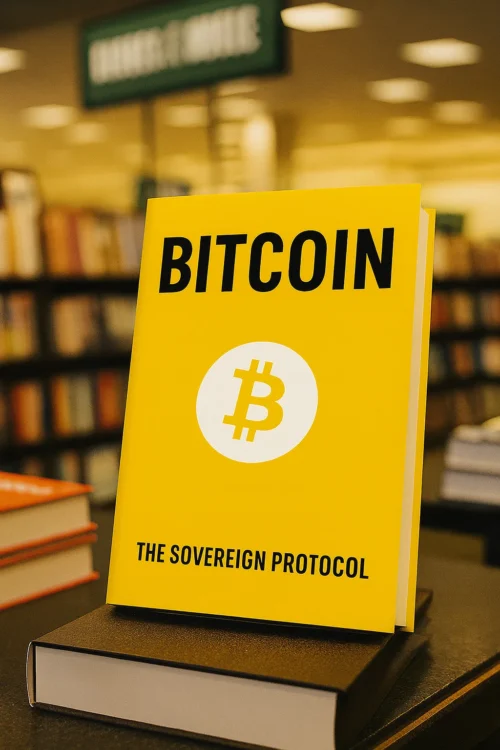
Bitcoin: The Sovereign Protocol – A 2026 Holiday Must-Read
A 233-page deep dive into the real evolution of Bitcoin – from military communication systems and early cryptography to ETFs, adoption, and the technology that made a new class of wealth possible.
A 2026 Holiday Must-Read: Bitcoin: The Sovereign Protocol Hits Shelves Just in Time for Christmas
As digital finance matures into a global force, few subjects inspire as much curiosity—or confusion—as the real origins and evolution of Bitcoin. This holiday season, a new release is arriving on bookshelves to cut through the noise. Bitcoin: The Sovereign Protocol, a 233-page deep dive into the true technological lineage behind Bitcoin, is now available on Amazon and positioned to be one of 2026’s standout tech reads and Christmas gifts.
Unlike most titles in the crypto category, this book avoids speculation, evangelism, and myth-making. Instead, it presents a grounded, research-focused account of how Bitcoin actually came to be—tracing its roots through decades of innovations that had nothing to do with digital money at the time. It’s the kind of book that appeals equally to crypto newcomers, long-time market participants, and anyone who wants a clear picture of how one of the most influential technologies of the 21st century emerged.
A Detailed Look at Bitcoin’s Unlikely Technological Ancestry
One of the central contributions of Bitcoin: The Sovereign Protocol is its exploration of Bitcoin’s non-obvious origins. The book walks readers through surprising pieces of the puzzle, including paths that run through military communication, cold war infrastructure, and the kind of cryptographic research that was never intended to power a financial asset.
Military and Submarine Communication Systems
Before blockchain was a concept, the military developed robust, fault-tolerant communication systems for submarines—systems resistant to failure, censorship, and single points of control. These architectures later informed distributed networking models that resemble some of the resilience properties Bitcoin relies on today.
The book connects these dots carefully, showing how ideas about survivable networks, secure channels, and nuclear-era redundancy influenced the conditions under which a protocol like Bitcoin could operate—without pretending that any of these systems were “secret early versions” of crypto.
The Cryptographers: The “Founding Fathers”
The book also profiles the researchers, mathematicians, and cryptographers whose work—sometimes decades old—laid the groundwork for Bitcoin. This includes pioneers in:
- Digital signatures and public-key cryptography
- Proof-of-work and computation-as-cost ideas
- Distributed consensus and fault-tolerant systems
- Early anonymous digital cash and e-cash experiments
None of these figures predicted Bitcoin, but their inventions became essential pieces of it. Rather than rewriting history to make them into proto-crypto founders, the book treats them as what they are: the indirect architects of a toolbox that Satoshi assembled into something new.
The “Ghost” Behind Bitcoin
Rather than rehashing speculative theories, the book examines the practical realities of Satoshi Nakamoto’s disappearance, how development continued in their absence, and how a protocol can outlive its creator. It positions the “ghost” not as a romantic figure to decode, but as a structural feature of the system: Bitcoin works because it does not need a visible founder anymore.
Spot ETFs and the Normalization of Bitcoin
A substantial portion of the book discusses the transition from early niche technology to institutional adoption. The arrival of Bitcoin spot ETFs in major financial markets marked a turning point: Bitcoin became a legitimate asset class for mainstream investors, retirement accounts, and global funds.
Bitcoin: The Sovereign Protocol details how this shift unfolded, why regulators changed their stance, and how these products accelerated Bitcoin’s integration into traditional finance. The book treats ETFs not as a moral victory or defeat, but as a realistic milestone in Bitcoin’s path from underground experiment to part of the global financial stack.
A New Class of Wealth and Innovation
Another section focuses on the explosion of innovation around Bitcoin—layer technologies, mining advancements, payment rails, and derivative markets. The book shows how these developments enabled:
- New professions built entirely around crypto infrastructure
- New business models in custody, trading, and tooling
- Early founders, miners, and builders becoming unexpectedly rich
- Global communities forming around open-source technology instead of centralized platforms
Rather than sensationalizing profits, the book contextualizes them as byproducts of a rapidly growing technological frontier. It explains how risk, timing, and understanding of the underlying protocol interacted to create outcomes that looked like overnight wealth from the outside—but rarely were.
Why This Book Matters Now
As Bitcoin enters its third decade, the narratives surrounding it have become polarized. Some see it as the future of money; others dismiss it as speculation. Most coverage lives at those extremes. Bitcoin: The Sovereign Protocol avoids that completely.
Instead, it provides:
- Neutral, well-researched explanations
- Clear technical breakdowns without drowning the reader in jargon
- Historical context without mythology
- Forward-looking analysis grounded in actual developments
It’s the kind of book someone can give as a holiday gift to a relative who’s curious about crypto, a colleague in finance, or a friend who keeps hearing about ETFs and blockchain but wants the facts—not the noise.
Where to Buy
Available now on Amazon (print & Kindle)
Search:
Bitcoin: The Sovereign Protocol
Publisher: BrainrotLabs.fun
Length: 233 pages
About the Author