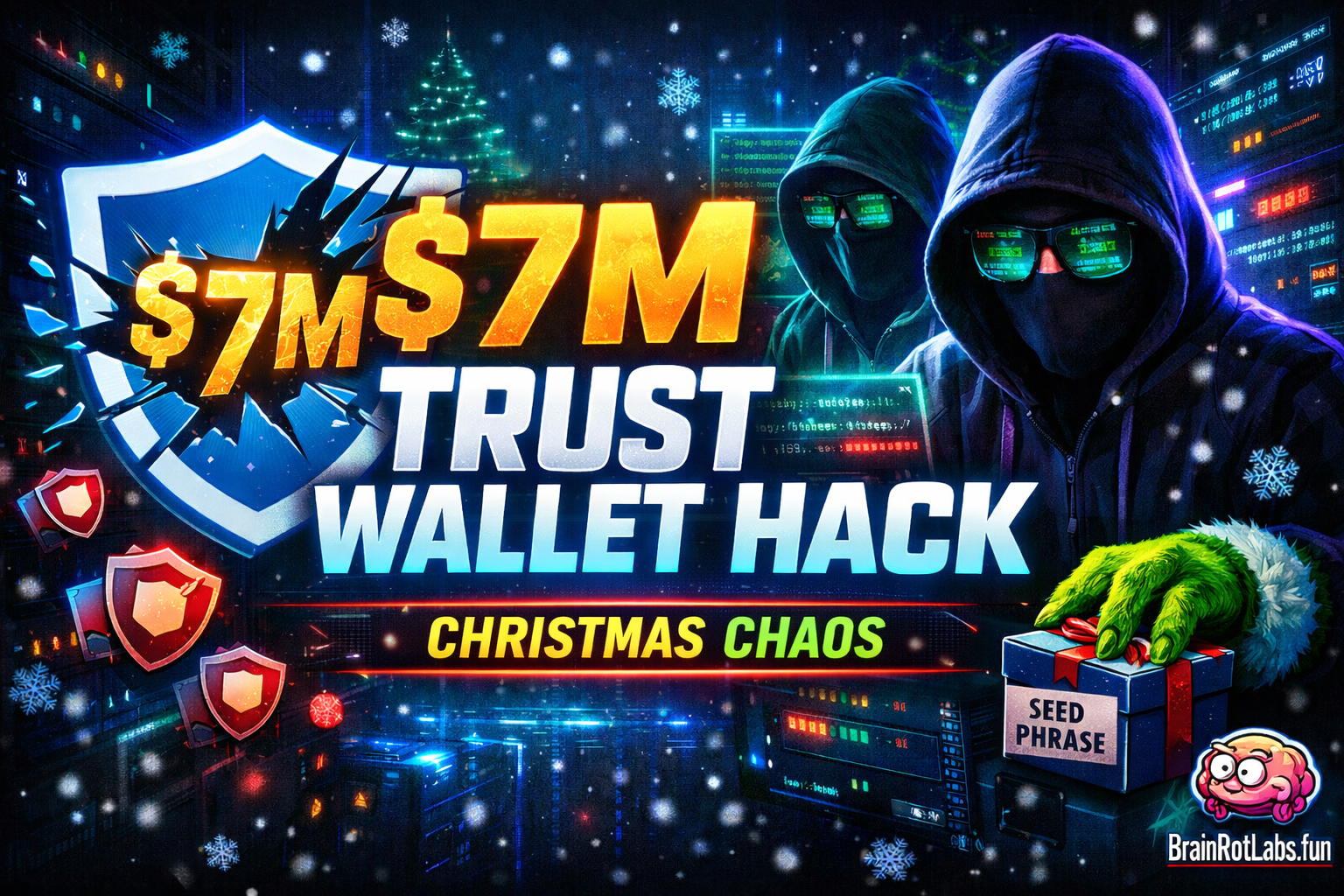
$7M Trust Wallet Chrome Christmas Hack – Why It Wasn’t Coinbase (and What It Means for Web3)
Over Christmas, a malicious update to the Trust Wallet Chrome extension quietly drained roughly $7 million from thousands of wallets – and the internet instantly mis-labeled it as a “Coinbase hack.” Here’s what actually happened, how Binance and Trust Wallet are responding, and what this means for anyone using browser wallets.
Christmas “Coinbase Hack”? It Was Trust Wallet’s Chrome Extension
In the days after Christmas 2025, social feeds and Telegram chats lit up with headlines about a “$7 million Coinbase hack on Christmas Day.” The sentiment was simple: yet another major exchange breached, millions gone, users wrecked.
The reality is more precise – and more important for anyone who touches Web3: the $7 million loss was not a direct breach of Coinbase’s systems. Instead, it was a supply-chain attack on the Trust Wallet browser extension for Google Chrome.
On December 24, 2025, a compromised version of the Trust Wallet Chrome extension, v2.68, was published. That build contained malicious code that quietly captured users’ seed phrases whenever they unlocked or imported their wallets. By the time the problem was discovered, attackers had drained roughly $7 million in multi-chain assets from nearly 3,000 wallet addresses.
At the same time, a separate story was still circulating: Coinbase’s insider-driven data breach and $20M extortion attempt. It’s no surprise that many people mashed the two incidents together and concluded “Coinbase got hacked for $7M on Christmas.”
For serious builders, traders, and long-term holders, it’s essential to separate headlines from facts. This article breaks down:
• What actually happened with Trust Wallet’s Chrome extension
• How the $7M Christmas hack was executed at the code level
• Why Binance and Trust Wallet are reimbursing affected users
• How this differs from Coinbase’s 2025 data breach
• What it teaches us about browser wallets and supply-chain risk
• How to harden your own crypto setup moving into 2026
Read: Bitcoin: The Sovereign Protocol
Our flagship book breaks down Bitcoin and the modern financial stack in plain language – so that when mainstream headlines scream “hack,” you actually know what you’re looking at.
Get the book
Christmas Week Timeline: From v2.68 to $7 Million Drained
December 24, 2025 – The Compromised Extension Goes Live
On December 24, a new version of the Trust Wallet Chrome extension, v2.68, appeared in the official Chrome Web Store. To most users, this looked like a routine update: same branding, same publisher, same listing.
Behind the scenes, the attackers had managed to get a malicious build approved. Reports suggest this involved abusing a Chrome Web Store API key or the publishing pipeline, effectively turning an official update into a trojan horse.
December 25, 2025 – Christmas Day Drains Begin
As users opened their browsers on Christmas Day and unlocked their wallets, the malicious extension quietly went to work. Whenever a user:
• Entered their seed phrase to import a wallet, or
• Unlocked the extension and decrypted the seed in memory
the injected code captured that data and sent it to attacker-controlled infrastructure. With the seed phrases in hand, the attackers began recreating those wallets on their own machines and sweeping funds across multiple networks.
On-chain sleuths, including prominent analysts like ZachXBT, started noticing coordinated outflows from Trust Wallet users across Bitcoin, EVM chains, and Solana. The pattern was too consistent to be random user error.
December 26, 2025 – Trust Wallet Confirms the Incident
By December 26, Trust Wallet publicly acknowledged what had happened:
• The issue was isolated to the Chrome browser extension v2.68.
• The mobile apps were not affected.
• Roughly $7 million in crypto had been stolen.
• At least 2,596 wallet addresses were confirmed impacted.
A fixed build, v2.69, was pushed, and users were told to:
1. Disable or remove the v2.68 extension immediately.
2. Install the updated extension from the official listing.
3. Move funds to fresh wallets if they had ever imported seeds via v2.68.
Binance co-founder Changpeng Zhao (CZ) echoed the message and confirmed the key detail the market was waiting on:
December 27–29, 2025 – Compensation & Forensics
As the story spread, Trust Wallet’s security team and external researchers dug into the code path of the malicious build. In parallel, a compensation portal was launched so victims could submit:
• Their affected wallet addresses
• The attacker’s destination addresses
• Transaction hashes of the draining transactions
• Contact details for follow-up
Trust Wallet also had to filter out noise: thousands of reimbursement requests came in, but nearly half were duplicates or from addresses that were never affected. This is the inevitable side-effect of any high-profile crypto hack – real victims mixed with opportunists.
Learn the Stack with Crypto Academy+
Our Crypto Academy app walks you from “what’s a wallet?” to multi-chain strategy, DeFi, and security pitfalls – including case studies just like this Trust Wallet incident.
Explore Crypto Academy+
Inside the Attack: How v2.68 Turned a Wallet into a Backdoor
From a technical point of view, this was not a typical phishing website or fake dApp. It was a supply-chain compromise, the kind of attack that hits the software delivery pipeline itself.
1. Compromised Build & Release Pipeline
To get a malicious build onto the Chrome Web Store under the real Trust Wallet listing, the attackers needed at least one of the following:
• Access to a valid Chrome Web Store API key or developer account
• Access to the internal build environment
• Ability to inject code into the packaging process
Security firms analyzing the incident noted that the attacker showed “deep familiarity with Trust Wallet’s source code and extension architecture.” This wasn’t a random script kiddie copying a GitHub repo – it was someone who understood how the extension processed wallet unlocks, seed handling, and network calls.
2. Seed Phrase Exfiltration
The malicious component masqueraded as an analytics or telemetry module. Once the extension was updated to v2.68, the added code:
• Hooked into flows where the user entered or unlocked their seed phrase
• Captured the mnemonic or key material in memory
• Exfiltrated the data to attacker-controlled domains
From there, the attackers imported those seeds into fresh wallet instances and initiated sweeps across Bitcoin, Ethereum, Binance Smart Chain, Solana, and other supported networks – emptying balances into consolidation wallets they controlled.
3. Multi-Chain Drains and Forensic Fingerprints
Because Trust Wallet is a multi-chain non-custodial wallet, a single compromised seed gave the attacker access to:
• BTC balances
• ETH and ERC-20 tokens
• BNB & BSC tokens
• SOL and Solana-based tokens
• Numerous EVM sidechains and altcoins
On-chain behavior followed a predictable pattern: victim addresses sending funds to a small cluster of attacker wallets, then onward to mixing flows, exchanges, and cross-chain bridges. Analysts quickly tied these tx patterns back to the time window when v2.68 was live.
So Where Does Coinbase Fit In? Two Different Hacks, Same Era
The reason many people framed this as a “Coinbase Christmas hack” is timing and headline overload. Just months earlier, Coinbase disclosed a serious insider-driven data breach and extortion attempt.
In that separate case:
• Cybercriminals bribed overseas customer support contractors to pull sensitive customer data.
• The stolen data included names, addresses, and other account details, but
did not include private keys.
• Attackers used the data for sophisticated social engineering,
impersonating Coinbase to trick users into sending funds.
• The attackers demanded a $20M ransom to keep the data private – which Coinbase refused,
instead offering a $20M bounty for information leading to their capture.
• Coinbase disclosed to regulators that the incident could cost between $180M and $400M
in remediation and reimbursements.
In other words, the Coinbase incident was an insider & data-layer breach, while the Trust Wallet Christmas hack was an extension & code-layer supply-chain breach.
For readers, this matters because it affects both:
• How you evaluate custodial platforms like Coinbase
• How you treat non-custodial tools like Trust Wallet, MetaMask, or any browser extension
What This Means for You: Browser Wallet Rules for 2026
If you’re reading BrainRotLabs.fun, you’re probably not here to panic. You’re here to adjust your strategy. Here are the practical rules this Christmas hack reinforces.
1. Treat Browser Extensions as Hot Wallets Only
Browser extensions are high-convenience, high-risk. They sit inside a huge attack surface: your browser, your operating system, every tab you open, every extension you install.
Use them like you’d use a wallet full of cash on a night out:
• Only keep what you’re willing to lose in an extension wallet.
• Keep long-term holdings on hardware wallets or non-browser cold storage.
• Never import your “cold storage seed” into a browser extension, ever.
2. Separate Your Seeds
One seed to rule everything is convenient – and dangerous. You’ll be far safer with:
• A “vault seed” – created and stored on a hardware wallet or cold environment, never
imported into browser extensions.
• A “daily driver seed” – used for interacting with dApps, DeFi, and NFTs via browser
wallets, with limited balances.
3. Watch Extension Updates Like You Watch Token Contracts
Most people obsess over checking token contract addresses but blindly click “update” on wallet extensions. This hack is a reminder to:
• Follow the official X / social channels of any wallet you trust.
• Pause if an update drops and you see simultaneous reports of weird drains.
• Disable first, investigate second, update third.
4. Treat Post-Hack “Compensation” Links as Landmines
Real victims of the Trust Wallet hack now have to navigate a second layer of risk: fake support pages and phishing forms claiming to “help with reimbursement.”
Golden rule: no legitimate team will ever ask for your seed phrase or private key, including during compensation. If a “Trust Wallet” or “Coinbase” form asks for it, it’s not support – it’s the attacker.
5. For Builders: Hardening the Human & Code Supply Chain
If you’re building in this space – wallets, dApps, DeFi protocols, or even infra – both Trust Wallet and Coinbase’s incidents are case studies you should be dissecting internally.
From the Trust Wallet side:
• Lock down release pipelines with strong key management & multi-person approvals.
• Sign builds and continuously monitor for unexpected code paths.
• Regularly audit extension and mobile code for anything touching seed handling.
From the Coinbase side:
• Assume insider risk is real at any scale.
• Monitor access patterns for support tools and customer data platforms.
• Drill your team on social engineering and bribery attempts – not just phishing emails.
? Quick FAQ: Trust Wallet Chrome v2.68 Hack
Was Coinbase hacked for $7M on Christmas?
No. The roughly $7M lost over Christmas came from Trust Wallet’s Chrome extension, not from Coinbase’s custodial systems. Coinbase’s main 2025 incident was an insider-driven data breach and extortion attempt, not a direct wallet drain.
Is Trust Wallet reimbursing victims?
Yes. Trust Wallet and Binance leadership have publicly committed to covering verified losses from the v2.68 browser extension exploit. Users must file claims through the official process and provide transaction evidence.
Were Trust Wallet mobile apps affected?
No. The incident was limited to the Chrome browser extension v2.68. Trust Wallet’s mobile apps were not compromised in this attack.
What should I do if I ever imported a seed into v2.68?
Generate a brand-new seed using a trusted wallet (ideally on hardware), move your remaining funds there, and treat the old seed as permanently compromised. Do not reuse it anywhere.
Want to Write for BrainRotLabs.fun?
We’re building a contributor network of traders, builders, analysts, and security nerds who can translate complex events – like this Trust Wallet hack – into clear, punchy breakdowns for the culture.
If you’ve got insight, receipts, or stories from the front lines of Web3, we want to read them.
Pitch your angle, submit past work, and let’s turn your research into features, explainers, and recurring columns on BrainRotLabs.fun.
About the Author